
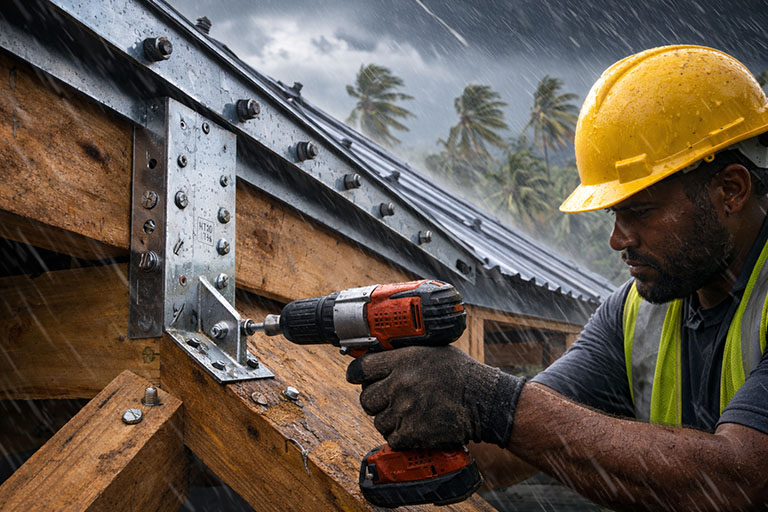
Jamaica sits in an active hurricane basin, and the difference between a building that comes through a Category 4 and one that does not is rarely the walls. It is the connections: whether the roof is genuinely tied to the ring beam, whether the ring beam is tied to the columns, and whether that load path runs unbroken to the foundation.
Duke Sterling designs and builds to the wind provisions of the National Building Code of Jamaica, which adapts the 2018 International Codes to the loading this island actually experiences. We also retrofit existing buildings, which is where most of the risk sits.

A roof is only as strong as its weakest connection. We build and verify the full chain from sheeting to foundation, because failure at any single link takes the whole roof.
We design to the National Building Code of Jamaica, which sets wind loading by location rather than applying one figure across the island.
Documented, code-compliant hurricane detailing gives you evidence to present to insurers, and a far stronger position on any future claim.
Whether we are building new or strengthening what you have, these are the elements that decide how a building performs in a storm.
Most of Jamaica’s housing stock was built before current wind provisions, and a great deal of it can be substantially strengthened without rebuilding. Retrofitting is usually a fraction of replacement cost and is best done outside hurricane season.

In most cases, substantially yes. Retrofit strapping, ring beam strengthening, improved sheeting fixings and protected openings together make a large difference to how a building performs. We survey first and tell you which measures give the most protection for the money on your particular property.
Usually the roof, and usually at a connection rather than in the material itself. Once the roof lifts, internal pressure rises sharply and wall failure often follows. That is why the load path from sheeting through to foundation matters more than the thickness of any single element.
Yes. We design to the NBCJ, which adapts the 2018 International Codes to Jamaican conditions and sets wind loading by location. Your parish and exposure determine the design wind speed we build to.
We cannot promise a specific reduction, as that is the insurer’s decision. What we can do is provide documented evidence of code-compliant hurricane detailing, which insurers increasingly ask for and which puts you in a stronger position both at renewal and at claim.
Outside the June to November hurricane season. Retrofit work often involves temporarily opening up the roof, which you do not want to be doing when a system is forming. We recommend planning retrofit work for the December to April window.
Storm resilience touches roofing, structure and aftercare.
New roofs and replacements built with proper hurricane fixing.
New homes built to current wind provisions from the ground up.
The natural moment to bring an older property up to standard.
Pre-season inspections and post-storm repairs.
Book a wind-resilience assessment on your property. We will tell you where it is vulnerable, what it would take to fix, and what it costs.